
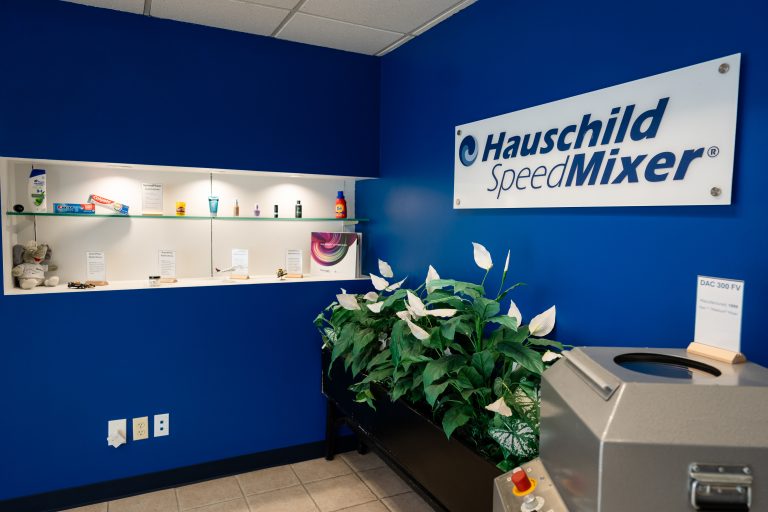
Hauschild SpeedMixer® employs dual-asymmetric centrifugal (DAC) technology, a process that allows for thorough and reproducible mixing of materials. Developed by Hauschild Engineering, every Hauschild SpeedMixer® centrifuge mixer is built by hand in Hamm, Germany. DAC mixing is used in laboratories and various manufacturing settings because it can efficiently blend materials without blades. Hauschild has a dedicated team based in Farmington Hills, MI, providing sales and technical support to North American customers, offering local expertise and prompt assistance.
Since its introduction, DAC technology has become a valuable tool in sectors like pharmaceuticals, composites, energy storage, and advanced materials. This method allows for precise mixing and can help reduce air entrapment and cross-contamination, which are known limitations of other mixing techniques.
This article provides an overview of current DAC mixing technology, discusses its practical applications, and references key published patents. It also highlights examples from published technical literature to illustrate how DAC mixing can improve efficiency, reliability, and reproducibility across different industries.
Mixing technologies such as vortex, planetary, and high-shear bladed mixers have long been used to process diverse material compositions in research and industry. While effective in many settings, these approaches can sometimes leave air pockets in mixtures or require more hands-on oversight to achieve complete blending.
Dual Asymmetric Centrifugal (DAC) mixing, as offered by systems like the Hauschild SpeedMixer™, introduced a new method by combining rotation and revolution motions. This design enables homogeneous mixing in a closed cup, reducing the risk of cross-contamination and minimizing exposure to air. Published studies and technical literature describe DAC’s utility for sensitive or multi-component materials, including applications in polymers, pastes, adhesives, and various research and manufacturing environments. DAC mixing is valued for helping users avoid the clean-up and wear-and-tear associated with traditional blade-based mixers.
Over time, DAC mixers—including those by Hauschild Engineering—have evolved from simple benchtop models to more advanced laboratory and industrial instruments. Many current models offer programmable mixing parameters, digital controls, variable speed options, and enhanced safety features to improve consistency and efficiency.
Recent developments in laboratory automation include mixers equipped with sensor integration and digital connectivity. Some DAC systems are designed to capture process data such as mixing time, speed, and temperature, supporting better documentation and process validation.
“SMART DAC” is Hauschild’s latest standard, referring to systems that incorporate expanded data tracking with more sophisticated user interfaces, IoT integration, and automated capabilities.
The Impact on Quality and Manufacturing
DAC mixing, when properly implemented, can support efforts to achieve batch consistency in formulations, reduce operator error, and streamline laboratory workflows. These improvements are particularly relevant in regulated environments such as pharmaceuticals and advanced materials, where consistency and reproducibility are critical. In the food, nutrition, and consumer products sectors, DAC mixers can support reliable blending and help minimize batch-to-batch differences.
By enabling more efficient laboratory workflows, DAC technology can contribute to reduced development times and more consistent results, which are important goals for R&D and manufacturing teams. However, realizing these benefits depends on appropriate model selection, validation in the intended application, and adherence to best practices for quality management.
Today, DAC mixers—including the Hauschild SpeedMixer™—are used across a wide range of industries such as pharmaceuticals, electronics, polymers, adhesives, and coatings. The versatility, scalability, and ability to handle sensitive or difficult-to-mix components have led to the adoption of DAC mixers for research, scale-up, and production tasks.
Integration of DAC mixers into digitally connected factory settings is underway in some industries, especially where closed-loop process control and electronic records are required. For organizations seeking to meet strict safety, traceability, and quality benchmarks, DAC technology is often one component of a broader suite of laboratory and process controls.
Patents related to dual asymmetric centrifugal mixing, including those assigned to Hauschild Engineering and others, reflect ongoing efforts to advance laboratory and industrial mixing methods. These patents often address vessel designs, mixing techniques, and system controls aimed at improving efficiency, adaptability, and process outcomes. However, it is essential to base any technical or regulatory claims on verified use cases and peer-reviewed evidence, as the mere existence of a patent does not guarantee broad industry adoption or confer regulatory standards.
Obtaining patents for DAC speed mixing represents recognition of specific technical concepts—such as innovations in vessel geometry or control systems. While these patents underpin proprietary solution development and may be referenced in certain regulatory filings, their presence alone does not establish industry-wide standards or guarantee compliance with regulatory requirements. Adoption is typically determined by separate, documented validation within each field.
DAC mixing patents continue to drive development and process improvement across diverse sectors. Nevertheless, their broad regulatory or commercial influence depends on supporting evidence, including published technical data and acceptance in relevant standards frameworks.
Claims regarding industry impact or mandated use should always be referenced carefully and supported with current, verifiable documentation.
Some patents, such as US20110160345A1, document specialized dispersing methods for materials like nanoparticles in electronics. While reported case studies and independent evaluations occasionally highlight benefits like improved yields, these outcomes are specific to the context of tested applications and need to be independently confirmed through published results or recognized technical assessments.
Thanks to innovation from Hauschild Engineering—the inventors of DAC technology and the SpeedMixer™—the trajectory of modern manufacturing has changed, unlocking rapid scaling, unmatched precision, and sustainability. Every advance traces back to their original vision and ongoing commitment to excellence.
When it comes to true innovation and reliability, accept no imitations. The Hauschild SpeedMixer® stands alone, offering patented precision and proven results across research, production, and advanced manufacturing. If you’re ready to elevate your process and achieve best-in-class outcomes, reach out to Hauschild SpeedMixer® today. Schedule a personalized demo or connect with our experts to learn why the original SpeedMixer™—still crafted by the pioneers who invented it—is the industry’s first and best choice for speed mixing innovation.